Walking Ireland
Part 1
This is the first installment in a story about how I traveled all the way to Europe with my seventeen-year-old brother in tow to have the epiphany that: one, I knew nothing about how to travel, and two, loved walking in Ireland in spite of my many missteps.
It was December 12, 2022, and the previous night, my trailer brake chamber seized and left me stranded waiting for repairs in Paris, Texas. I browsed flights on the library computer for somewhere to take my brother Dan. He had his senior year spring break coming up in April, and I was on a mission to take all eight members of my family on a one-on-one trip to someplace they had never been. He was the first I would yank out of his carefree high school days to the sometimes rewarding stress of international travel.
Considering his youth and inexperience, it was better to tell him where he wanted to go rather than ask. The two cheapest flights abroad were to Egypt and Ireland. I could not think of more to do in Egypt than ride a camel, look at the pyramids, and get harassed by the notorious scammers of that shifty nation, so Ireland won. Only slightly more sophisticated than a coin toss. Sorry, Egyptologists, it is just not my interest. And I was buying, so Dan would never know I had ruled it out.
I booked two round trips to Dublin from Toronto with his connection from Windsor and mine out of Newark. I was below the legal age to rent a car, so an Irish road trip was out. A day in Dublin would be about all I cared for touring a big city, and neither of us had sophisticated tastes for food or shopping, so I searched up something to do out in the countryside.
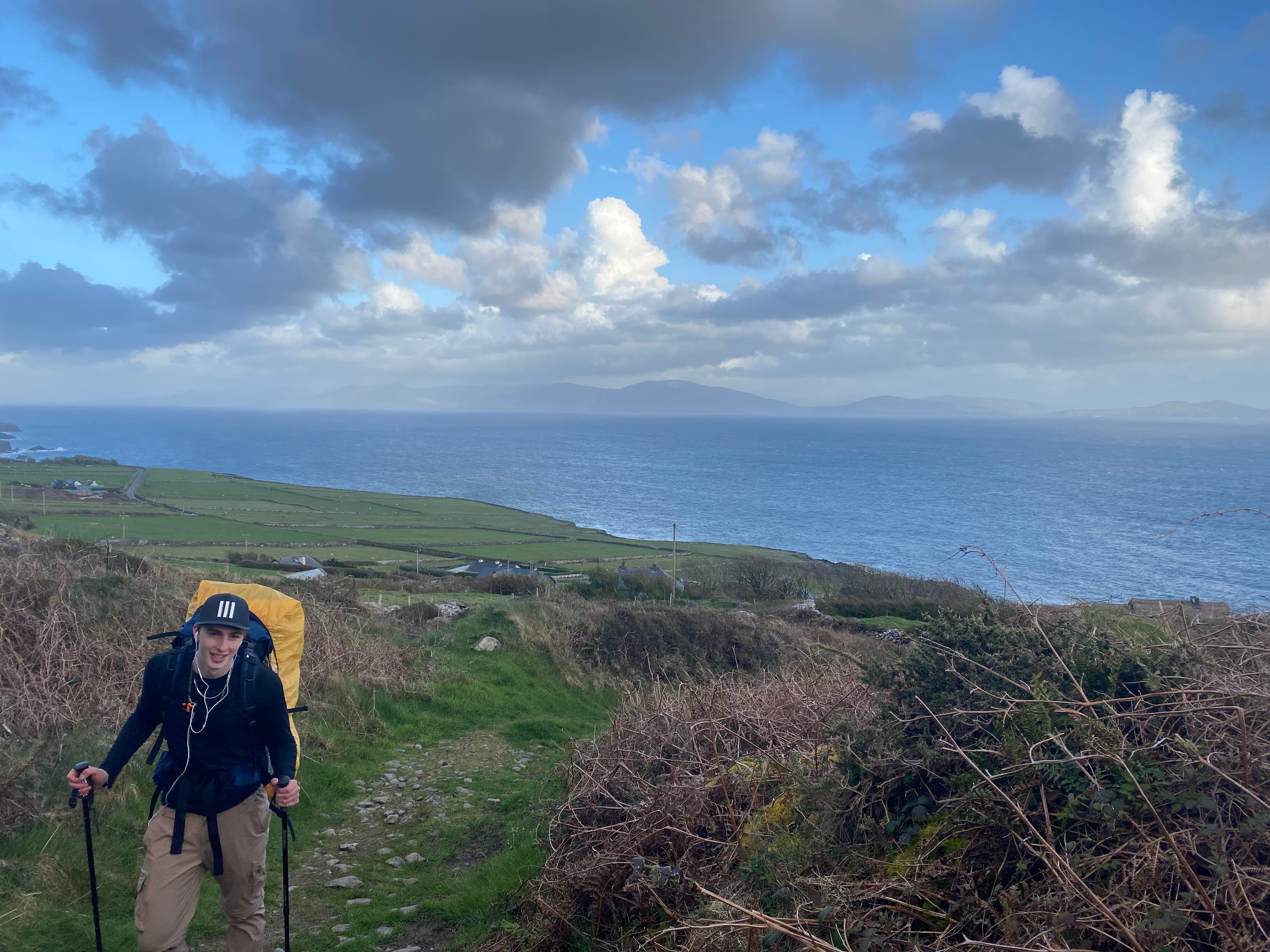
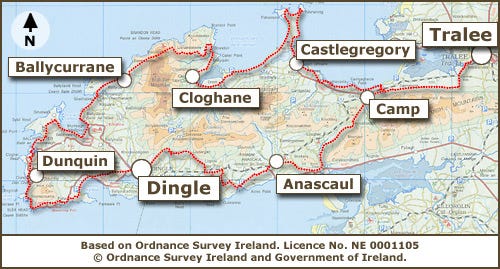
The Dingle Way, a 112-mile footpath through rugged County Kerry in the west of Ireland, kept coming up in my searches, and I printed the route information from the trail’s website. That, the flight itinerary, confirmation for an Airbnb in Tralee where the trail begins, and a hostel in Dublin for the night before the return flight completed my planning, and I hole-punched the slim stack. The Republic of Ireland holds the gate open to American passport holders; there was nothing I had to do immigration-wise. I secured a license from the Irish Aviation Authority to fly my drone, and putted around for anything else I could think of. After giving the country’s Wikipedia page a once-over, I drummed my fingers on the computer table and scratched my empty head. It looked to me like the plan was sorted. Nothing else to print.
Dan opened the three-ring binder with a picture of a sheep on the front on Christmas morning and flipped through the pages.
“I'm going to Ireland?” he asked.
“We’re going to Ireland,” I corrected him.
“Oh… sweet. Ireland,” he grinned up at me and back through the pages.
I followed a rail-thin woman at a distance around the Newark Airport because she was carrying a pizza box but was too skinny to eat the whole thing. About ten minutes later, my instinct for scavenging food paid off when she set the box on the lid of a trash can and walked away, four slices untouched.
“That pizza I scavenged gave me really bad gas,” I joked to Dan, who had sat in a different middle seat further up the plane. “But everyone blamed a fat guy in the aisle seat so I think I’m good.” We laughed on the walk to immigration, and I asked him if he got the meal.
“Well, everyone else got… like a ham and cheese thing, but they handed me these nasty fish and vegetables. I asked the lady why, and she said it was because mine was Kosher.”
“Oh…” I remembered. “When I was booking the flight, it asked if we had any special needs and I said that you were a Jew.”
“Bro! Why?”
We plodded around Dublin’s colliding aesthetics, passing the hours until the train at Heuston Station departed for Tralee. Pubs with wood signs and heavy doors squatted beside antiquated stone quays on the River Liffey under the glimmering flash of European headquarters for American tech companies like Facebook, Microsoft, and Google. The cars had little lions or chrome diamonds as manufacturer’s logos, and were much smaller than commuter cars in the States.
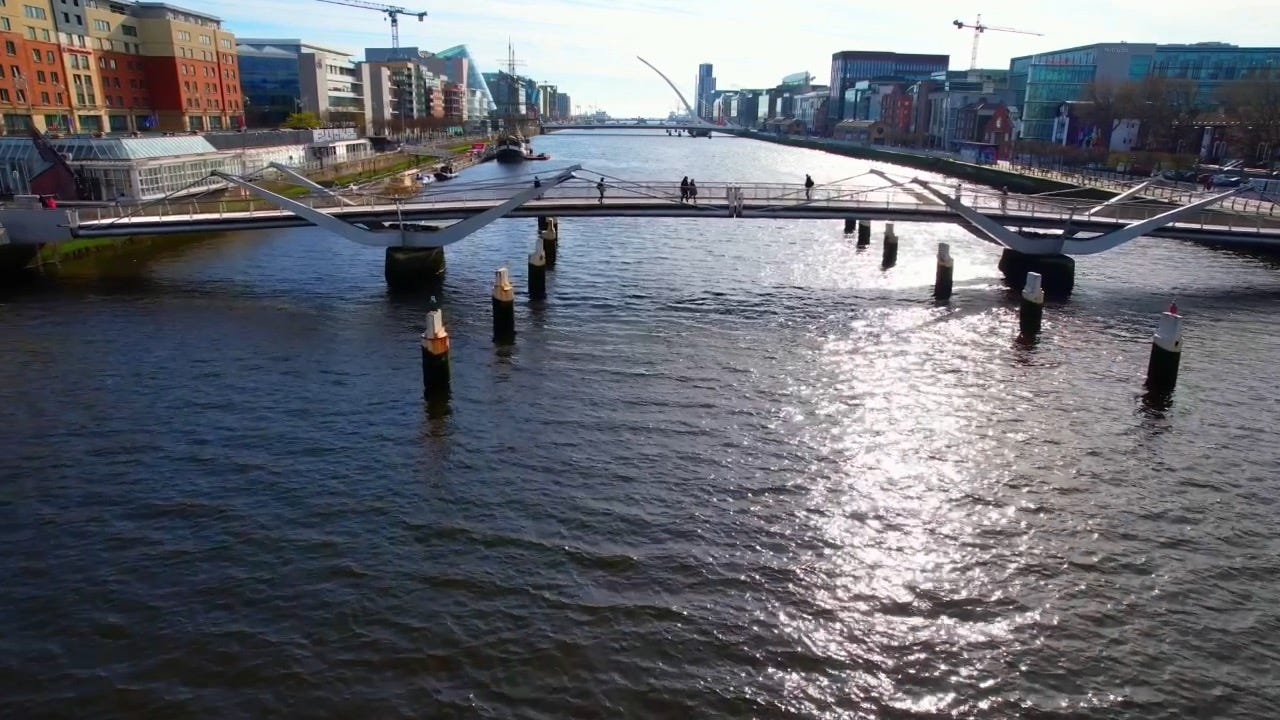
The electric poles and even the fire hydrants were skinnier, and streets were arranged to give people and vehicles roughly equal space to move through the city. Signs were in the shape of an arrow instead of a rectangle, and their words spelled out the name of things in many consonants and accent marks above their English spelling. Some were only spelled once, like the red octagon signs that read STAD instead of STOP. Wikipedia had noted Ireland was English-speaking, but now I wondered.
We caught a street car to an outdoor store where I asked for a canister of isobutane camping fuel that I could not bring on the plane. I asked also for the other item I could not find in advance, a map of County Kerry.
“Why the f— are you going to Kerry?” the clerk asked.
“To hike the Dingle Way,” I said.
“Aye, Dingle Way,” he responded. “Dingle Way in Kerry.”
“Do you know where we can camp out there?” I asked, bearing in mind my American understanding of private property where signs like ‘All trespassers will be prosecuted’ and ‘Due to the cost of ammunition, no warning shot will be fired’ are common and not easily ignored.
“Yah, you and your man can camp with the sheep. There’s nobody lives out there ‘sides the sheep. And it’s a Gaeltacht besides.”
“What’s that?” I asked.
“It’s… they still speak the Irish and keep things going the old way without property development and the like.” His answer explained what those words were above the English on all the street signs. There was an Irish language. I kept expecting to hear its sound, but was left wanting. It seemed like speaking the native tongue in Ireland was like using the metric system in America. Both things happen in controlled environments. Irish is spoken at folk events and the metric system is used in laboratories and military operations, but neither have made it to the vernacular. Both systems were good in theory, but neither nation could quite shake its British influence adequately enough to implement what was best for them.
We sat together on the train, backpacks on the floor and the green, rocky countryside zipping past. Small cars waited on the left side of the road to cross after the train went past and cattle munched on the grass in wide expanses between mild-toned wood and stone villages. I gathered from the couple seated in front of us that they considered the four-hour train passage a long trip. It was shorter than the drive we have taken many times to visit our grandma up north in Michigan, but to the Irish, this was a proper coast-to-coast journey across the country. The Republic is about the size of West Virginia but with almost three times the population density. With so much more packed into the twenty-six counties, a person did not have to go far to find what they needed, and few indeed found it in the west of Ireland. To us, it was a short trip. To the Irish, a long haul.
After terminating in Tralee, we bought groceries at Lidl with nutrition marked in grams and kilojoules, which made it sound more scientific, but free of the sludge of high fructose corn syrup and numbered food dyes, which made it seem more edible. We bought food ready to eat and a few things to heat in the stove, thinking there were plenty of villages to top off along the way. The church and book shop were the only two things open after checking in with the landlady at the Airbnb and so we visited, unladen by our bulky kits.
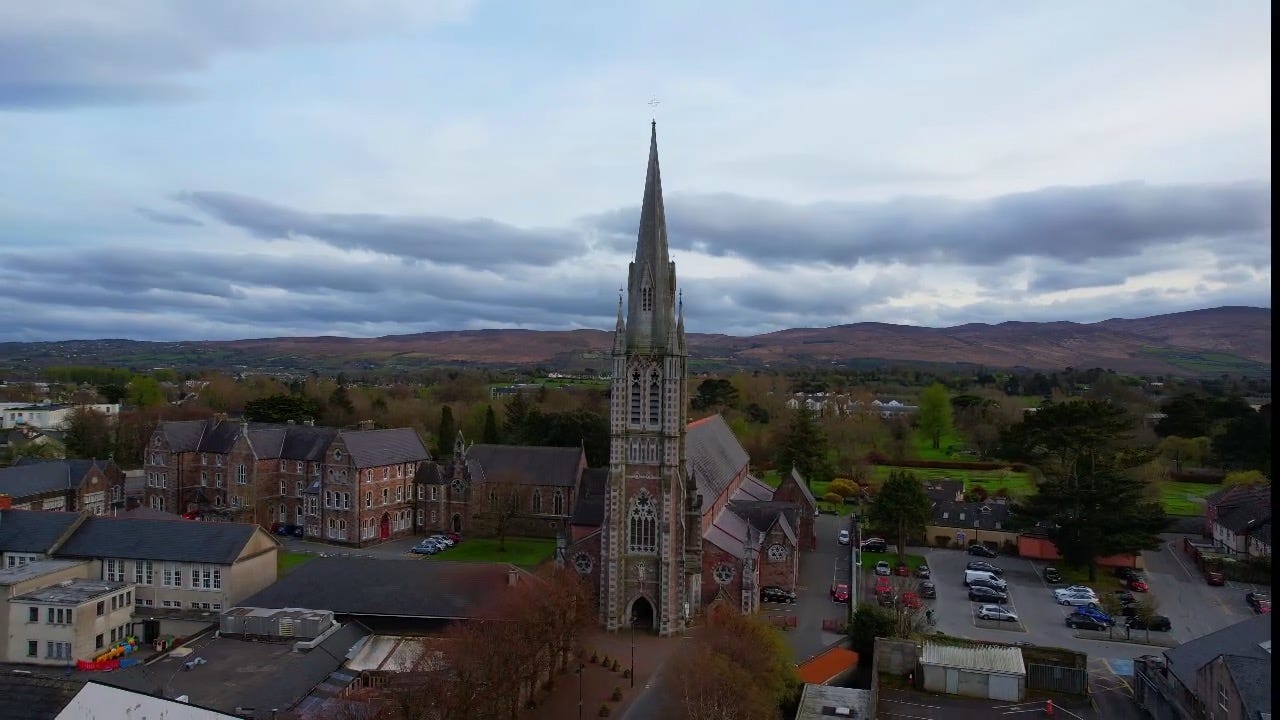
St. John’s (completed 1860) was a grander structure than any in town, with brick and limestone in layers like teeth of a wide-gauge zipper up its octagonal bell tower and pointed arches supporting the roof in the Gothic Revival style. This house of God was as dominating as any cathedral in America but served a much smaller town and sprawled out back to the cemetery and green fields. This value on space showed that it is, or was when it was built, a great value to the people both because of its great expense and because it occupied so much space in a town where other buildings were packed in tight. We would see its opposite when we packed into a tiny chapel for Easter morning mass a few days later.
The bookshop owner claimed to be a polymath, which he translated into American English as ‘natural genius’, and literally cornered us between the seafaring and fiction bookcases as he ranted about the bastards who governed the world. Russia’s president was on the block for starting a war that raised prices all over Europe. But in the moment, we were a convenient outlet for his poly-whatever rage because we were American, and the American president, in his estimation, was the biggest bastard of them all.
I’m a huge fan of the accent; even in angry tones, the Irish lilt is a cheery sound that levitates between speaking and singing. I could have gone without the rant, but the accent was, and would be, a highlight of the rest of my interactions with people on the trip. It was a vacation for my ears from the flat and loud tones of English as it is spoken on the other side of the Atlantic. Dan and I mimicked the enraged Irishman on the rocky road back, trying to get the sound just right.
Back at the flat, I could not crack the cipher that was a light switch and used my phone’s flashlight to stumble into the last shower I would have for the next week. A white chunk the size of a microwave stuck out from the water pipe, and I only knew what it was because of the handwritten sign taped to its front. 'PLEASE MIND THE QUIET HOUR AND DO NOT USE THE WATER HEATER AFTER 21:00'. I told myself the cold shower was out of consideration for the quiet hour and not the truth, that I had no idea how to make it a hot one.
The next morning, we touched the sign that marked the start of the Dingle Way and marched up the levee beside the River Lee out of town. Here, I saw my first and only reference to the book I had read in preparation for the trip. The black graffiti on a white wall read 'BRITS OUT'. I learned that Ireland was actually two separate countries by reading that book. I had, naturally, picked up a book about Northern Ireland, in essence, the wrong Ireland. I read the intriguing tale through in spite of it having zero mentions of the backwater where Dan and I now found ourselves. Here, the ‘Brits’ had been out since 1922, and the Republic was fully out from under the crown since leaving the Commonwealth in 1948. Sympathy for the northern situation still reverberates down the isle though.
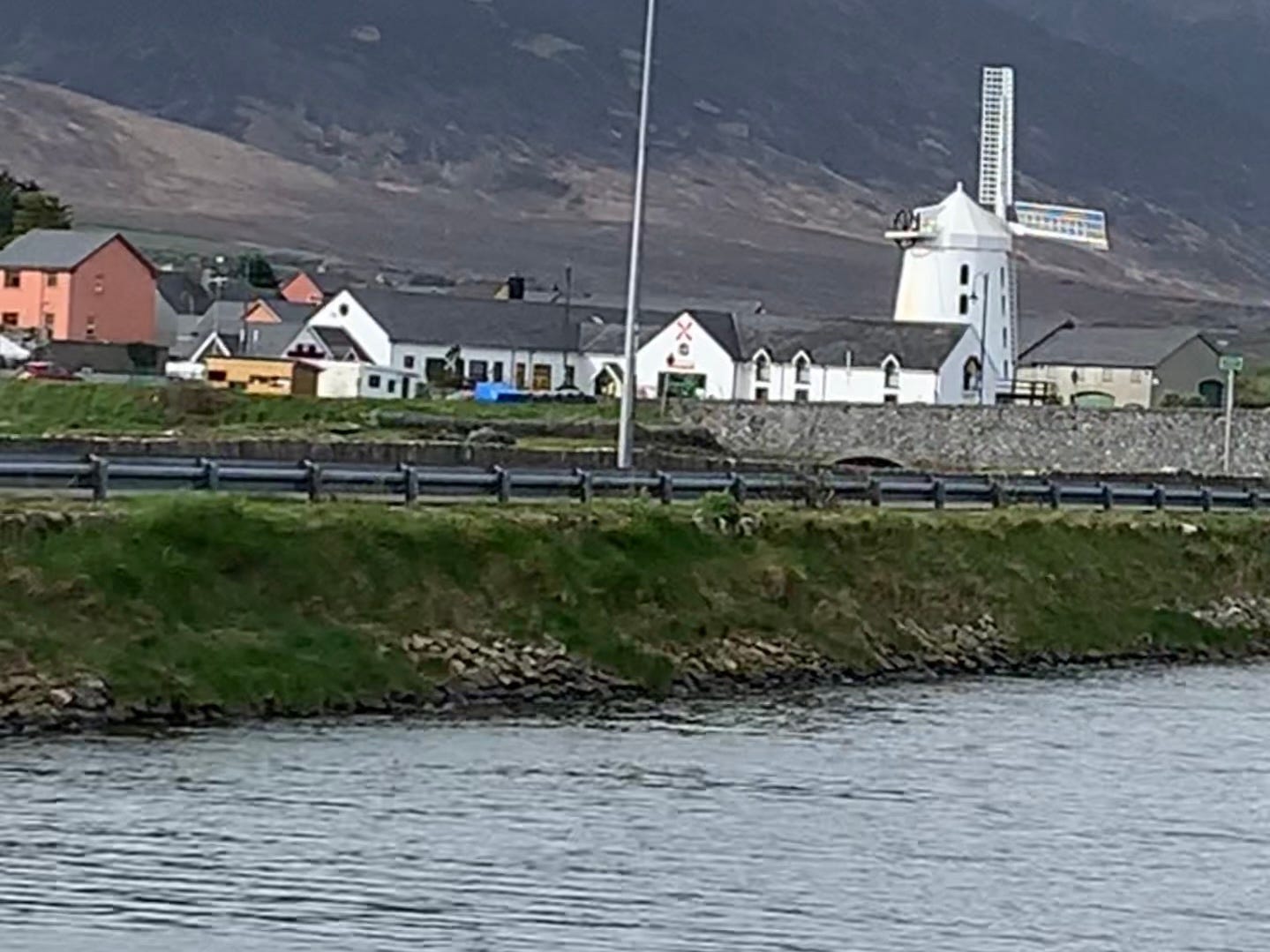
The wide blades of an old-fashioned windmill faded behind a hill and St. John’s bell tower vanished for the last time. Dan and I were out in the country now. We took lunch in a turnout where a one-legged shepherd hopped out of his truck and chased his Collie toward the gate near where we were spread out. I feared we had presumed too much and went to get out of his way, but he waved me back down. It was not the "get-off-my-lawn" treatment I had grown up knowing in Michigan.
We camped on a little patch of grass that night close to the town called, literally Camp. To my delight, no one pointed a shotgun at us. I later learned that trespass is classified as a tort in Ireland, meaning (if I understand law correctly and that’s a big if), that consequences arise if there are damages, and only when a person refuses the landowner’s request to leave, not before. But no one ever did.
Dan asked one of the ranchers if he could please pet a sheep.
“If you can catch one,” the man joked.
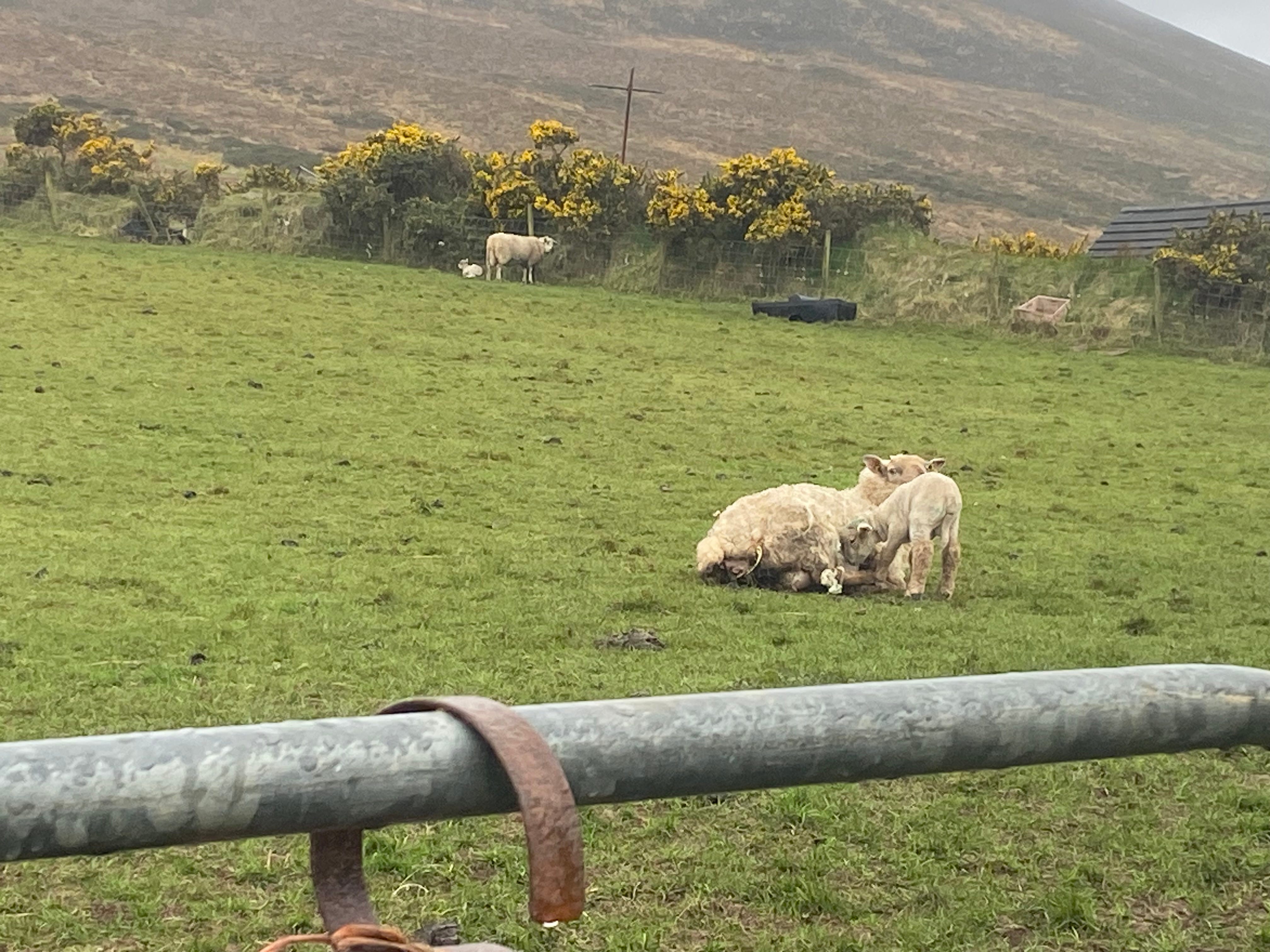
The attitude towards travelers on private land reflected what that rancher allowed for his flock. If you can catch a sheep, you can pet it. And if you can find a place to camp, you can use it.
